Welcome to the February 2026 release notes from Virto Commerce! As we close out the last month of winter and look ahead to warmer days, this release brings targeted enhancements that refine core workflows, strengthen platform capabilities, and improve day-to-day efficiency. And while February is known for Valentine’s Day, we’re sending our appreciation and care to our customers all month long!

Key updates:
- Platform upgrade to .NET10
- Virto OZ chat integration to the Vendor Portal
- Virto Commerce is a Founding Member of the Commerce Operations Foundation (COF)
 Upgrade to .NET10. Platform 3.1000.0
The Platform has been upgraded to .NET 10 to provide:
- Improved runtime performance.
- Iincreased stability.
- Access to the latest long-term support (LTS) versions of core and third-party libraries.
| Feature | .NET 8 | .NET 10 |
|---|---|---|
| Runtime performance | JIT optimizations, dynamic PGO, SIMD improvements. | Further enhanced JIT inlining and method devirtualization, broader hardware acceleration (e.g., AVX10.2, Arm64 SVE), improved loop and stack allocation performance. |
| C# language support | C# 12 with productivity and safety enhancements. | C# 14 with richer language constructs (field-backed properties, lambda parameter modifiers, extension blocks) improving expressiveness and maintainability. |
| ASP.NET Core / Web APIs | Strong minimal APIs, improved routing and middleware performance. | Expanded diagnostics, modern authentication options (e.g., passkey), improved SSE/streaming support, better API observability. |
| Entity framework core | EF Core 8: query performance improvements, JSON mapping enhancements. | EF Core 10: LINQ translation improvements, enhanced performance, named query filters, and better Cosmos DB support. |
| JSON serialization | Improved System.Text.Json (interface hierarchy, customization). |
Additional JSON options (strict settings, duplicate property handling) and performance tweaks for robust API payload processing. |
| Diagnostics & observability | Built-in metrics API, structured logging. | More extensive metrics and tracing, including richer event data and better integration with monitoring tools. |
| SDK & tooling enhancements | Native AOT publishing, container support. | Enhanced CLI tooling (introspection, tab completion), better container/image workflows, improved build reliability. |
| Security & auth | Updated crypto and authentication foundations. | Broader auth support (e.g., passkeys), secure defaults, and improved TLS/platform support across OSes. |
| Platform ecosystem support | MAUI and platform targets improved for cross-platform UI. | Additional MAUI enhancements and runtime stability on devices/platforms. |
 What’s new in NET10
What’s new in EF 10 Core
What’s new in ASP.NET Core 10
Below is the average execution time of key platform requests ( .NET8 /
  .NET10):

Load testing was performed in a Virto Commerce Cloud environment using test data.
Upgrading your Vicrto Commerce Platform is easy and includes just a few steps:
1. Install .NET 10. Begin by ensuring that you have .NET 10 installed on your system. Follow the official installation guidelines to set up the environment for the upgrade.
2. Update Virto Commerce Platform to v3.1000 or above.
3. Update Customer and XAPI modules to v3.1000 or above.
4. Update other Virto Commerce Modules to Stable Release 12 and later.
By default, Virto Commerce Platform on .NET10 is backwards compatible with previous platform stable releases on .NET8 (3.800+). However, it is recommended to update custom modules to the latest versions to leverage new features and improvements.
Improved integration with Azure Application Insights. Frontend 2.40.0
The Platform now provides improved visibility into GraphQL request execution in Application Insights. Previously, when GraphQL errors occurred no operations were visible. This made it difficult to determine which pages initiated GraphQL operations. With this improvement, you can browse the list of pages in Application Insights and click through to view all related GraphQL operations and execution details:

Markdown pages support. Frontend 2.40.0
Users can now create pages using Markdown, in addition to the existing Designer (block-based) and HTML options. Markdown pages can include tables, images, lists, and other standard formatting elements, providing a lightweight and developer-friendly way to manage content.
To make a Markdown page accessible after publishing, users must assign a slug, which is used to resolve and display the page on the frontend:

Admin UX improvements. Page Builder 3.834.0
The Page Builder interface has been updated to improve navigation clarity:
-
The main menu now displays page statuses, giving users instant visibility into content lifecycle distribution:
This makes it easier to track content state and quickly navigate to the relevant pages.
-
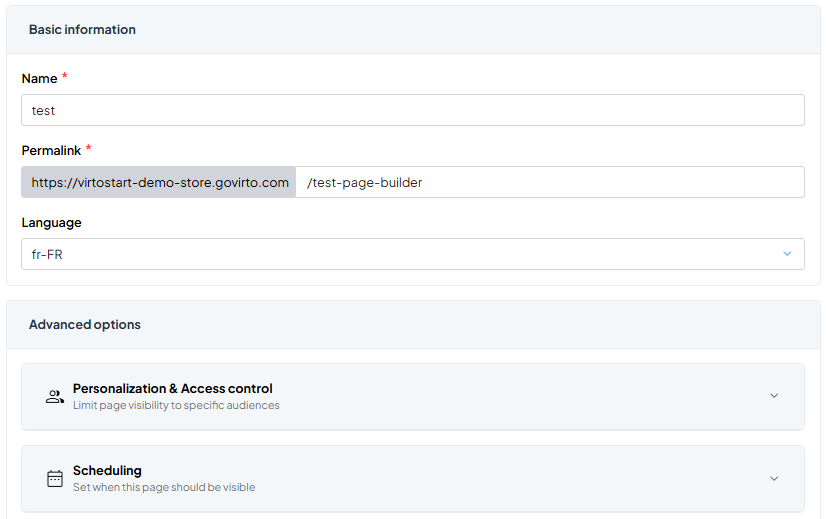
The page editing blade has been reorganized for better usability and clarity:
-
Fields are now grouped into Basic and Advanced sections:
-
The domain is displayed in read-only mode as part of the permalink, providing clearer context without the risk of accidental changes.
-
A Scheduling section (collapsed by default) allows users to enable scheduling and define start and end dates. Once enabled, the section automatically expands:
- A Personalization section (collapsed by default) enables targeted content delivery. When expanded, users can select the intended audience:
- Everyone.
- Registered users only.
- Selected user groups.
- Selected organization only.
-
-
The grid view of pages has been improved and new color badges have been addded:



Range slider support for any numeric properties. Catalog 3.910.0
Any numeric property (decimal or integer) can now be configured to use a range slider:

Based on a partner request, the range slider functionality has been extended beyond price aggregations to support any numeric property (decimal or integer). Previously, range sliders were available only for price ranges, as numeric properties were processed as multiple term-based filters, which prevented Elasticsearch from calculating the required min/max statistics.
As a result, partners can now configure range-based filtering for any numeric attribute, delivering a more flexible and consistent search and filtering experience across catalogs.
Coupon Usage Visibility and Analytics. Marketing 3.825.0
This update introduces enhanced visibility into coupon usage, giving merchants clear insight into how promotions are actually applied. In addition to seeing discount amounts, users can now track how many times a coupon has been used and identify which customers applied it. Coupon information is also visible directly on the order, providing full transparency at every stage:

The Promotions list has been enhanced with new default columns (status, coupon availability, dates, description), visual status icons, advanced filtering, and extended context actions. Promotion details now include a Usage History widget showing how often a promotion was applied across orders, line items, payments, and shipments, with direct navigation to the relevant orders. Order-related blades have also been improved with a Discounts widget that lists all applied promotions in one place:

Enhanced delete confirmation. Customer 3.850.0
To prevent accidental data loss, deletion actions for companies and contacts now include an enhanced confirmation dialog. The popup clearly displays the number of selected companies and/or contacts slated for deletion and requires users to explicitly type “yes” to confirm the action:

Marketplace and VC-Shell. AI assistant integrated into the Vendor Portal
Virto Commerce Marketplace now includes Virto OZ, an AI assistant natively integrated into the Vendor Portal as a dedicated chat experience, not just a toolbar action.
Vendors can interact with Virto OZ through a familiar chat-style interface. Simply select any item in the portal, such as a product, and open the AI blade to start a conversation. From there, Virto OZ can assist with a wide range of tasks, including:
- Generating or improving product descriptions.
- Analyzing sales data and identifying top-selling products.
- Creating summaries and reports based on vendor data.
- Suggesting content or data improvements for selected items.
When Virto OZ proposes changes, such as updating product content or adjusting item attributes, vendors can apply those changes directly by confirming the action in the chat, without leaving the current context.
This conversational, context-aware approach makes working with data and content faster, more intuitive, and accessible bringing AI assistance directly into everyday vendor workflows.

Key capabilities:
- No-code configuration: AI behavior can be configured without development.
- Context awareness: Understands selected entities, pages, and user intent.
- Multi-agent orchestration: Complex requests are handled by specialized AI agents working together.
- Batch operations: Apply changes to multiple items in a single interaction.
- Task planning & session continuity: Long-running or multi-step tasks are preserved across sessions.
- Real-time streaming: Responses and results are delivered progressively.
- Live preview & approval: Review AI-generated changes before applying them.
- Module auto-discovery: Automatically adapts to installed Marketplace modules.
- Multi-tenant architecture: Securely supports multiple vendors and organizations.
- Enterprise-grade security: Aligned with Virto Commerce access control and permissions.
- MCP protocol support: Enables extensibility and integration with external AI tools and services.
For more information, request a demo
AI capabilities reminder
-
Virto OZ: An AI-powered assistant that helps users navigate the Virto Commerce platform, find relevant documentation, and get contextual guidance while working with platform features.
-
AI-generated product information: Because the Virto Commerce Frontend integrates with Google Tag Manager (GTM) through the GA module, it can now automatically support additional third-party SaaS tools that rely on GTM, such as Product Guide. Product Guide can be connected to our Frontend by simply adding its script or tag to GTM. No custom Frontend development, code changes, or manual script injection into the Frontend are required:

Ecosystem and community highlights
-
Virto Commerce is proud to announce that we are a Founding Member of the Commerce Operations Foundation (COF), making this our first technology alliance of 2026.
The Commerce Operations Foundation is a newly established, vendor-neutral nonprofit organization created to advance open standards for modern commerce operations. Its mission is to address one of the most persistent challenges in commerce today: the lack of a shared, interoperable standard between selling channels and fulfillment systems. -
We recently visited our partner, Innovadis BV, for an in-person exchange focused on the future of digital commerce. The discussions covered composable architectures, scalability in complex B2B landscapes, and the growing role of integrations along with AI and sustainability as key strategic drivers. These face-to-face conversations helped align our visions and reinforced our shared commitment to building smarter, more sustainable commerce solutions:
-
We’ve published a new strategic asset inspired by our recent webinars on composable commerce. The Digital Commerce Roadmap outlines key principles, architectural approaches, and practical steps for building flexible, future-ready commerce solutions with Virto Commerce. It’s a valuable reference for teams planning or evolving their composable commerce strategy.

Documentation
-
Based on our recent training sessions, we’ve published two new articles in the community focused on GraphQL. They explore how GraphQL differs from REST, outline best practices, and explain why Virto Commerce adopted GraphQL as a core part of the Platform architecture:
-
A new community article has been added to explore a critical observability insight: how CPU overload can distort duration metrics in Application Insights, why this matters for performance monitoring, and how to interpret telemetry more accurately. This is a valuable read for teams relying on App Insights for end-to-end performance diagnostics and SLAs: