Welcome to the December 2025 release notes from Virto Commerce! As we wrap up the year, we’re bringing you a fresh collection of improvements that enhance performance and deliver an even smoother experience across the Platform. Let’s explore what’s new this month!

Key updates:
 Virto Commerce recognized as a Niche player in the 2025 Gartner Magic Quadrant for Digital Commerce
 Google tag Manager integration
 xFrontend module first release
Virto Commerce advances upward and rightward in the 2025 Gartner Magic Quadrant
Virto Commerce has been recognized as a Niche player in the 2025 Gartner Magic Quadrant for Digital Commerce - our second consecutive year in the report.

This placement reflects our continued progress in execution and vision. As our founder and CEO, Alexander Siniouguine, notes, Virto’s mission is to build the last ecommerce platform our customers will ever need: flexible, powerful, and ready for change.
Being a Niche Player highlights our focus on delivering cost-effective, customer-centric B2B ecommerce solutions. Our composable architecture, advanced AI capabilities, and commitment to client success have earned the trust of global enterprises.
Among 160 monitored vendors and 19 featured this year, Virto Commerce was one of the few that moved up and to the right - a strong signal of our momentum.
Watch and listen a podcast with Jason Greenwood, Virto Commerce’s Alexander Siniouguine and Denis Clifford “Why does Gartner Magic Quadrant for Digital Commerce still matter?”
Pickpoint search improved. Frontend 2.35.0
Pickpoint search results can now be narrowed down using facets such as country, state/province, and city

Managing pickup locations
xPickup module queries
Expandable variations on category page. Frontend 2.35.0
In the list view, all of the product’s options can now be expanded directly beneath it on the same page. This is intended to allow customers to add all desired variations to the cart without navigating to the individual product detail page.

This feature is currently available only for the desktop view.
Pages customization for different organizations. Page Builder 3.829.0 + Builder.io 3.806.0
Both in Page Builder and Builder.io, pages for different organizations can be customized so that each organization’s users see only the content intended specifically for them:

Customizing pages for different users
Floating menu for mobile view. Frontend 2.35.0
A floating bar has been implemented for the mobile page view to provide quicker access to key actions. This remains accessible as the user scrolls, leading them directly to the desired action:

Improved error messaging. Frontend 2.35.0
Error messages are now more clear and user-friendly. A friendly message is displayed providing the ability to report the error. The second message informs users that all errors are tracked, registered, and that the team is aware of the issue:

Enhanced product reviews accessibility (a11y). Frontend 2.35.0
The product reviews block is now fully available via keyboard navigation and passes all accessibility tests:


Unified display of quantity and stock alert fields. Frontend 2.36.0
To improve usability and ensure a unified experience on the product details page, the quantity fields and Stock Alert field are now displayed consistently across both the variations list view and the table view. Quantity fields now follow the same layout, styling, and alignment in both views. Stock alert field uses consistent design, placement, and formatting across views.

Google Tag Manager (GTM) integration through Google Analytics module. Frontend 2.35.0 + Google eCommerce Analytics 4.805.0
The Platform now integrates Google Tag Manager (GTM) with the Google Analytics 4 (GA4) module and the Frontend. This enables digital marketing and analytics managers to centrally manage analytics tags, pixels, and conversion events within GTM, eliminating the need to modify frontend code:

Because the Virto Commerce Frontend integrates with Google Tag Manager (GTM) through the GA module, it can now automatically support additional third-party SaaS tools that rely on GTM - such as Product Guide. Product Guide can be connected to our Frontend by simply adding its script or tag to GTM. No custom Frontend development, code changes, or manual script injection into the Frontend are required:

Google Analytics 4 and GTM integration
Configurable SMTP headers. Notification 3.829.0
Store administrators can now add, edit, and remove custom SMTP headers directly in the SMTP provider settings. This allows for advanced cloud email feature configuration without requiring developer intervention or code changes:
"Notifications": {
    "Gateway": "Smtp",
    "DefaultSender": "noreply@gmail.com",
    "Smtp": {
      "SmtpServer": "smtp.gmail.com",
      "Port": 587,
      "Login": "",
      "Password": "",
      "ForceSslTls": false,
      "CustomHeaders": {
        "X-Custom-Header": "value",
        "X-Custom-Header2": "value2"
      }
    },
Store dynamic properties exposed to Frontend. xAPI 3.925.0
Store dynamic property values can now be retrieved via Store API (X-API) queries. This allows store administrators and front-end developers to use these values in the storefront without needing to extend or customize the API:
query GetStore($domain: String!) {
  store (domain) {
    storeId
    storeName
    catalogId
    dynamicProperties{
      name
      valueType
      value
    }
  }
}
xFrontend module first release
The new xFrontend module has been created to introduce a unified pageContext query that optimizes how Frontend retrieves initialization data. This module extends the Virto Commerce GraphQL schema and aggregates several essential backend calls - Store, User (Me), Whitelabeling, and Slug Info - into a single optimized request:
query GetPageContext {
  pageContext (
    domain: "localhost"
    storeId: "Electronics"
    cultureName: "en-US"
    permalink: "/"
    organizationId: "OrganizationId"
    userId: "UserId"
  ) {
    slugInfo {
      entityInfo {
        id
      }
    }
    store {
      storeId
    }
    whiteLabelingSettings {
      logoUrl
    }
    user {
      id
      userName
    }
  }
}
By providing this consolidated query, the xFrontend module significantly reduces the number of API calls required during store bootstrap, improves First Contentful Paint (FCP), and simplifies frontend integration. Without this module, storefronts must continue using four separate requests to gather the same data.
In short, the xFrontend module is the backend extension that delivers the new unified pageContext query for more efficient Frontend rendering.
| Metric | Before | After | Difference | Result |
|---|---|---|---|---|
| FCP | 2136 ms | 1672 ms | -464 ms faster |  Improved Improved |
| SI | 4255 ms | 4124 ms | -131 ms faster | Slightly improved |
| LCP | 4787 ms | 3247 ms | –1540 ms faster | Improved |
| TBT | 169 ms | 168 ms | –1 ms | Stable |
| CLS | 0.14 | 0.08 | –0.06 improvement | No change |
Active sessions management. Platform 3.915.0
A new security feature allows Virto Commerce administrators to review and revoke active user sessions across the Platform. If unusual behavior is detected, you may terminate all active sessions simultaneously or one by one:

Environment badges. Platform 3.916.0
A new pinned badge has been added to the top of the admin interface to clearly display the current environment (e.g., Prod, Staging, Test, Dev, Demo). This visual marker helps administrators instantly identify where they are working and reduce the risk of performing critical actions in the wrong environment:

Virto Commerce on .NET 10 (Alpha release)
Virto Commerce is now available in an early alpha version running on .NET 10. This update brings the platform to the latest .NET 10 LTS release, delivering improved performance, security, and long-term support.

UI kit
-
A new UI Kit component now supports products with 2 to 4 color variations. You can assign multiple colors to a product. One color can be marked as the primary color and displayed on top for 2-3 color sets or in the top-left corner for 4-color sets. All secondary colors are displayed automatically in a random order:
-
We’ve improved scrolling behavior in layouts where the main content is short but the sidebar is tall: when users scroll to the bottom of the page and expand a facet, the layout now behaves correctly even while products are loading:


Marketplace
-
A new AI-Helper application has been embedded directly within the VC-Shell:
-
A comprehensive logging system for AI requests has been implemented to improve debugging and transparency. The logging supports two configuration levels:
-
Minimal: Logs technical information only.
-
Verbose: Logs the full context, including the prompt, request, response, and any error messages.
-


For more information, request a demo
VC-Shell
-
An AI-powered code generation tool for VC-Shell applications has been introduced, utilizing the Model Context Protocol (MCP).
- Fully automatic: Capable of generating complete modules with a single command.
- Broad compatibility: Designed to work with modern AI-assisted development environments including Cursor, VS Code, Claude Code, and Codex.
- MCP integration: The current implementation integrates 15 tools and 10 resources to streamline the development workflow.
-
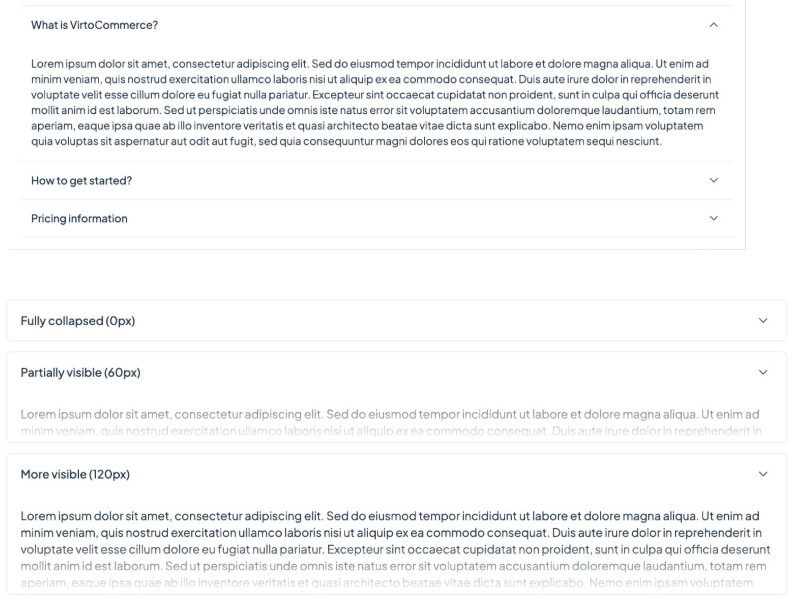
A new
VcAccordioncomponent has been introduced to the Shell’s UI library, expanding the available toolkit for interface development.- Customizable collapsed height: Show partial content in collapsed state
- Maximum expanded height: Limit height with scroll for very long content
- Smooth animations: Fluid expand/collapse transitions
- Smart overflow detection: Automatically hides expand button when content fits
- Gradient fade effect: Fades out bottom of collapsed content
- Multiple variants: Default, bordered, and separated styles
- Single/Multiple expansion: Control whether multiple items can be open
- Controlled/Uncontrolled: Works with or without v-model
- Demo in Storybook
-
A
useBladecomposable has been introduced to provide a blade instance without usinginject(BladeInstance)and simplify integration and usage.

Explore the new features and capabilities
Webinars
We’ve recently organized a webinar, a perfect format of direct, open communication with everyone interested in the realities of composable commerce. Our first webinar was devoted to clean data, timeless engineering principles, and preventing integration chaos. You can now watch the full recording on YouTube:
Thanks to the success and high engagement of the first session, we’ve decided to continue the conversation. Our second webinar will take place on December 15, and this time it will be a fully conversational panel focused on what actually happens inside real B2B digital projects.
-
Composable Commerce in Real Life. Part 2. Registration
Featuring:
Alexander Siniouguine, Founder & CEO - Virto Commerce
Oleg Zhuk, CTO - Virto Commerce
Stefan Vissia, Senior Product Manager - Innovadis
Jacobi Zakrzewski, VP Technology Strategy - Luminos Labs