September brings a broad set of improvements across the Virto Commerce platform. This release makes Sales Rep Hub more powerful for managing customer relationships and adds finer control over multi-organization customer memberships. We’ve also strengthened the admin experience with accessibility, mobile, security, and usability improvements.

Highlights
- Sales Rep Hub major updates.
- Smarter multi-organization customer management.
- Product stock quantities visibility per fulfillment center.
Sales Rep Hub enhancements
The Sales Rep Hub, which lets selected users serve a defined set of customer organizations, grew in the following directions this release:
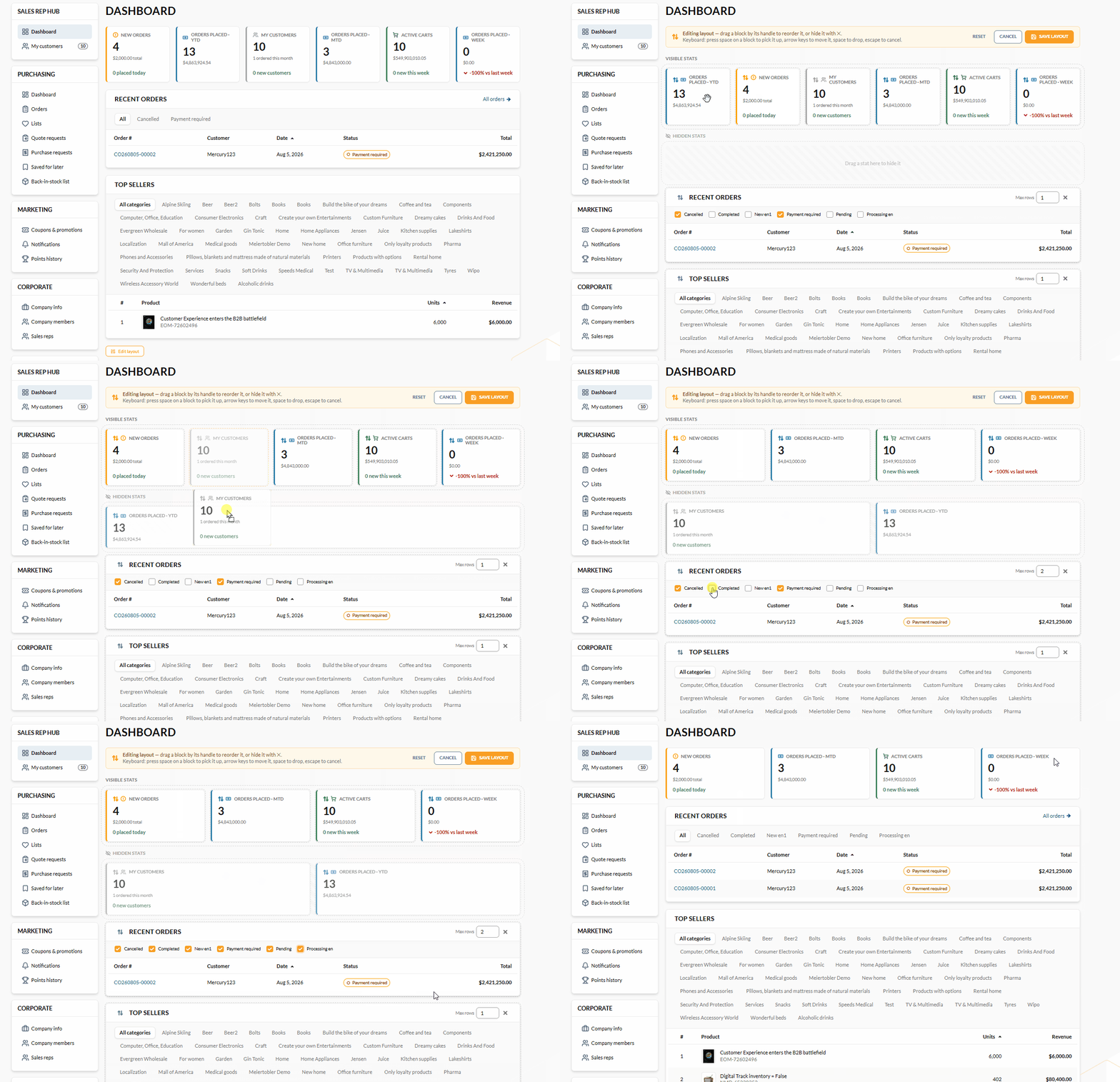
Customizable dashboard layout. Sales Rep 3.1002.0
A sales rep can now drag and drop dashboard widgets into the layout that fits how they work, and that layout is saved and restored across sessions and devices:
Customer sales data and top-products queries. Sales Rep 3.1003.0
A new set of GraphQL queries gives the Hub Dashboard and the customer profile page their numbers: month-to-date and year-to-date order totals with year-over-year comparisons for a customer organization, a ranked list of that organization’s top products by revenue or units, and the cart and customer counts behind the “My customers” dashboard tiles. Sales rep dashboard filters now show only the statuses and categories the rep actually has activity in, scoped to the organization and period on screen.
 CustomerOrderStatistics
TopSellers
CustomerCartStatistics
CustomerCounts
OrderFilterRules
Shared document library for sales reps. Sales Rep 3.1006.0
A sales rep is able to publish a shared document library, catalogs, lookbooks, pricing sheets and sales guides, that a customer can open or download from their own account.

Invites and status for multi-organization customers. Customer 3.1021.0
A company administrator can invite an existing customer to their organization, resend or cancel pending invitations, and approve, reject, or lock that user’s membership. These actions only affect the user’s membership in that organization and do not affect their membership in any other organization:

On the Frontend, users can view and accept or reject pending invitations from their account dashboard. The organization switcher only shows organizations where their membership is active.

 Breaking changes:
- The invite flow now sends new
organization-invitenotification templates instead ofRegistrationInvitationEmailNotification.Any store-level customization of the old templates stops taking effect and there is no automatic migration. - The nine new templates ship English-only.
- A global contact status of Rejected or Deleted now blocks sign-in for every organization the contact belongs to, unless a membership-level override exists.
Managing organization membership status
Product stock quantities visible per fulfillment center. Inventory 3.1005.0
A fulfillment manager can now open a fulfillment center and see the stock quantity of every product held there, instead of only a store-wide total.

Viewing products in a fulfillment center
Logging in UCP. UCP 3.1005.0
UCP requests are now traced end to end with OpenTelemetry, so a failure inside the xAPI catalog search shows up in the Platform’s existing observability tooling instead of disappearing at the protocol boundary.

Improved backup and restore for catalog images and files. Backup and Restore 3.1005.0
Backup and restore is being extended to handle catalog images and files reliably, streaming binaries instead of routing them through the browser:

New notification template editor. Notification 3.1013.0
The admin notification template editor moves from one long vertical scroll to a compact, tabbed workspace: a live preview, a proper JSON editor, variable autocomplete and a full-screen editing mode.

Restriction of admin sign-in independently of API permissions. Platform 3.1054.0
A new PlatformUI configuration section lets an administrator decide whether an account may sign in to the admin back-office UI, separately from the permissions that account holds. This makes it possible to give a non-staff account, for example a customer calling protected platform or module API endpoints, access to the API without ever exposing the admin panel to it.
"PlatformUI": {
"Access": {
"AllowAdministrators": true, // administrators bypass all rules
"RequireAnyPermission": true, // the pre-existing rule
"AllowedAccountTypes": [], // e.g. [ "Manager", "Administrator" ]
"AllowedPermissions": [], // masks: [ "platform:*", "catalog:*" ]
"DeniedPermissions": [] // masks; wins over AllowedPermissions
}
}
Replacing AutoMapper. Pickup 3.1004.0 + Catalog CSV Import/Export 3.1003.0 + Profile Experience API 3.1016.0
Following up on the AutoMapper vulnerability advisory, the team is replacing AutoMapper across the Platform with explicit, hand-written mapping.
Approach to replacing AutoMapper
Dark themes. Frontend 2.55.0
The dark mode for our Mercury theme has been updated, and a dark mode has been added for the Red theme. Dark mode is now available for Mercury, Coffee, Watermelon, Black-Gold, and Red.

Organization schema publication on the homepage. Frontend 2.55.0
Every store can now publish a structured, machine-readable profile of its brand identity on its home page, its name, logo, social profiles, contact information and founding date. AI shopping agents read this Organization schema to confirm a store is who it claims to be and to link the store’s other agent-facing data back to a recognizable entity.
<script type="application/ld+json">
{
  "@context": "https://schema.org",
  "@type": "OnlineStore",
  "name": "Yourstore",
  "url": "https://yourstore.com",
  "logo": "https://yourstore.com/logo.png",
  "sameAs": \[
    "https://twitter.com/yourstore",
    "https://www.instagram.com/yourstore"
  \],
  "contactPoint": {
    "@type": "ContactPoint",
    "telephone": "+1-800-000-0000",
    "contactType": "Customer Service"
  }
}
</script>
An administrator configures the schema per store, with a default value that can be reverted to at any time, and the Frontend renders it on the home page as JSON-LD, along with Open Graph meta tags that improve how the store’s link previews in chat apps and social feeds:

Adding randomness to the product export file name. Catalog CSV Import/Export 3.1004.0
Exported product-catalog CSV files now get a random 6-digit token appended to their file name, so the download link can no longer be guessed:

Update product reviews design. Frontend 2.56.0
The product-reviews widget on the product detail page is getting a redesign:
- A fractional-fill star rating.
- A pluralized review count.
- Enhanced images preview.
- A keyboard-navigable carousel for customer-submitted review photos.

/llms.txt brand brief publication. Frontend 2.56.0
A store is able to publish a /llms.txt brand brief:

Thus, AI shopping agents can read its policies, product categories and agent capabilities directly, instead of guessing at them:
# llms.txt
# Public brief for AI agents about Yourstore
# About
One or two sentences on what you sell, who you sell to, and any defining context.
# Product Categories
- Category one
- Category two
- Category three
# Policies
- Returns: 30 days, full refund.
- Shipping: free over $30, 3-5 business days.
- Any other policy worth surfacing, for example cruelty-free, vegan, made-to-order.
# Agent Capabilities
- UCP manifest: /.well-known/ucp
- Supported flows: cart, checkout, tokenized payment.
- Anything explicitly not supported, for example no subscription products via agent.
# Contact
support@yourstore.com
Simplified email and push notification options for a shared wishlist. Frontend 2.56.0
Sharing a wishlist with a customer will always notify them on both channels, email and push, instead of asking the sharer to choose which channels to use each time.

QA
This release adds vc-perf, a new performance-diagnostics plugin for the vc-tools marketplace that any developer building on Virto Commerce can install locally, and reworks the team’s own internal QA pipeline that tests the live product.
vc-perf
vc-perf measures performance across three layers, each covering what the other two miss:
-
L1, BenchmarkDotNet. A code-level A/B comparison between two revisions, an override against the stock code path, or an upstream before/after, with repeatable allocation and timing numbers.
-
L2, a k6 load harness. The live system’s behavior under real concurrency: throughput, p95 latency and GC pressure.
-
L3, dotnet-trace. Attribution: allocation churn, on-CPU time and database command shape, traced back to the call sites that produced them.
A single command, /perf-loop, routes an operation to the layer or layers it needs and returns a ranked list of candidate fixes. /perf-fix and /perf-verify hand a candidate to the existing developer and reviewer agents, then confirm the change actually improved the measurement. vc-perf is advisory only and never gates a build.

Risk-proportional QA pipeline. Agentic QA project
The team’s internal test pipeline, /qa-test, routes each ticket along two dimensions:
- Which flow it needs (a ready-to-verify bug fix goes straight to a fast verification pass instead of full feature testing), and
- How much depth that flow gets (a small, single-layer change takes the fast path; anything cross-layer, high priority or revenue-critical takes the full path). New test cases are written directly into the production suites instead of going through a separate promotion step, and a failed run now returns a triaged list of actions instead of raw failures that still need interpreting.
The pipeline’s own reference material, the business-rules oracle and the edge-case library, is now checked against documentation, live behavior and the platform source on every review. Its first run found twenty dangling citations across seven test suites.

Marketplace
Vendors configuring a product can now set a default value for a configuration option, mark a section as conditional so it only appears when an earlier choice requires it, and set a maximum length on a text-type section. Order line items that include a configuration now show the configuration’s section name, so buyers and fulfillment staff can see at a glance what each selected option belongs to.

For more information, request a demo
VC-Shell
-
Improved WCAG 2.2 accessibility. Improved keyboard navigation, focus management, tap targets, and accessible labels across VC-Shell. Fixed issues with the side menu, dashboard widgets, resize controls, popups, blades, and the scheduler component. Added support for password manager autocomplete and localized ARIA labels.
-
More reliable session-expiry handling. Improved how expired sessions are detected and handled. Users are now redirected to the login page instead of being sent to blades that cannot load, and error messages no longer expose raw server responses.
-
Improved VcDataTable mobile experience. Fixed mobile card view issues with scrolling, row expansion, bottom rows, and image column widths.
-
Keyboard shortcuts now available across vendor portal modules. Keyboard shortcuts are now fully supported and used across all vendor portal modules. Tooltips automatically display the appropriate key combination for the user’s operating system.
-
Hardened AI assistant panel. Improved security and keyboard interaction for the embedded AI assistant panel, including more reliable shortcut handling and keyboard-based panel dismissal.
Explore the new features and capabilities
Documentation
The documentation site now provides a rolling Edge version that continuously tracks the main branch. Numbered documentation versions are released alongside each Platform stable release.
Knowledge hub
-
Podcast: Why Digital Transformation Fails (And How to Fix It)
Denis Clifford (Virto) talks with Scott McIntyre and Jon Blum of Infinite Green about why B2B replatforming projects stall — and it’s rarely the stack. The argument: teams pick a vendor before they’ve defined the business problem, then bend the org to fit a pre-built solution. Useful if you’re at the RFP stage and the requirements doc is really a feature checklist. -
Podcast: Digital Commerce for the Circular Economy
Denis Clifford joins All Things Circular’s Victoria D’Arcy and Peter Evans on what breaks when you run resale, refurbishment, and take-back on a platform built for one-time sales. Covers lifecycle-aware product data, where manufacturers lose margin to third-party resellers, and the data plumbing behind digital product passports, warranty tracking, and carbon reporting.
Circular Commerce and the New B2B Tech Stack Podcast -
Playbook: How Leading FMCG, Beverage, and Foodservice Brands Modernize B2B Commerce
A 12-page playbook built around three real modernizations — HEINEKEN, De Klok Dranken, and Lavazza by Bluespresso — all dealing with high-frequency reordering while expanding into new markets and channels. Includes an evaluation framework (two buying situations, five activation forces) and a self-diagnostic for spotting where the platform, not the strategy, has become the ceiling. -
2026 Gartner® Hype Cycle™ for Digital Commerce
Virto is named a Sample Vendor in two profiles: Composable Commerce and API-Based Digital Commerce. The 2026 cycle puts agentic commerce, AI checkout, and answer engine optimization at the innovation trigger, with marketplaces, distributed order management, and personalization further along. Gartner’s evaluation guidance centers on trading architectural flexibility against total cost of ownership.